In life we don’t often get the chance at do-overs. How would things be different if I had the brain of today to solve yesterday’s challenge?
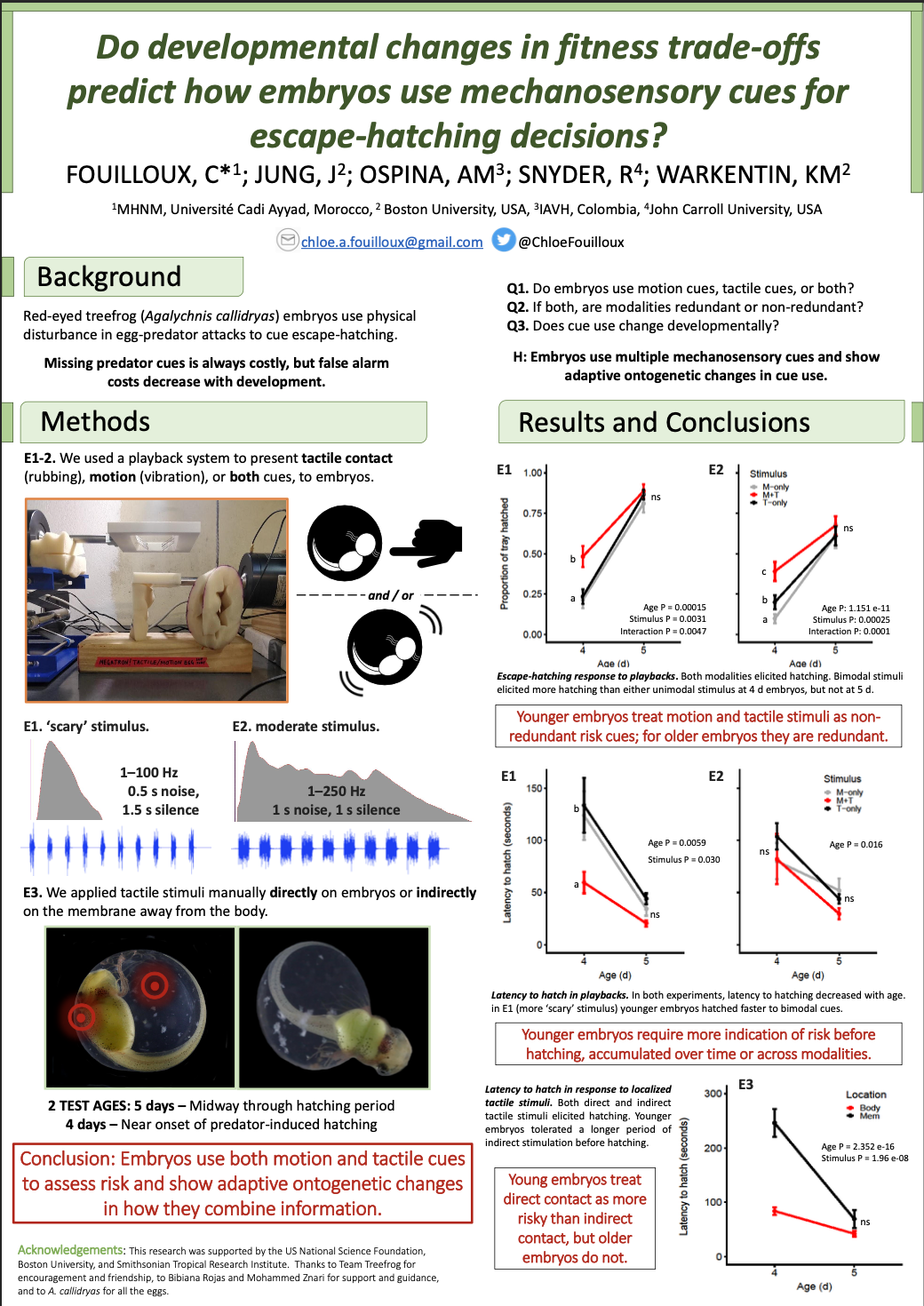
Well, I had the rare opportunity to do just that by being able to redesign a conference poster from my very first Ph.D conference in 2019 at ESEB in Turku, Finland. I had just barely started my program at the University of Jyväskylä and was presenting work I had done in Panamá with Karen Warkentin while living in Morocco working with Mohammed Znari. It was quite the time for a tadpole to be hatched into the big ol’ pond of science.
If you want to another example that more explicitly outlines design concepts, check out the work I did with Eldon’s poster redesign here.
Hey #eseb2019, thank you for creating such a wonderful opportunity to learn and present during the first poster session. Lucky for feedback and constructive criticism on my presentation and work. Please support a young and eager scientist by voting for poster 61 on the app! 🐸🤓 pic.twitter.com/JMJqd8CDfr
— Chloe Fouilloux (she/her) (@ChloeFouilloux) August 21, 2019
So, what changed five years later? First, I restrict poster content to my golden 250-word limit. Make the threshold for engagement at low as possible: bold colours, bold images, bold. . . everything. I also aim to go for repetition in shape use by capturing the circle of the egg in the repetition of circles throughout the poster. Finally, I aim for a more consistent use of colour by limiting my palette for emphasis and narrative flow. If you find yourself really challenged by these constraints, make a QR-code as a kind of “supplementary materials”– if people really want to know what your set-up looked like, they’ll scan it. You can throw additional plots and references on there too.
So, take the leap! Dare yourself to look over your old work. Be kind to who you were and bathe in the warmth of how wonderfully far you’ve come. I can’t wait to see how I would shred all my previous work five years from now!
Adapt or die. That’s the motto– and across our amazing tree of life we see mind-bending examples of animals adapting to their environment for the sake of success and survival.
Here again we are carried to the world of poison frogs. In these experiments we focus on phytotelm-breeders– in other words, frogs that deposit their tadpoles into small pools of water formed by vegetation. Think about a leaf axil, palm bract, or treehole.
Tadpoles are stuck in these minuscule pools until metamorphosis. Albeit minuscule, these pools represent an entire world for a tadpole– they may only be the volume of a coffee cup, but until this point, our little tadpole friend has never been anywhere else in its entire aquatic life. For a tadpole, a pool is the beginning and end of their universe. The water they live in, the creatures they interact with, the rise and setting of the sun– all of this has only ever been experienced from within the confines of a leaf axil.
And that really got me thinking.
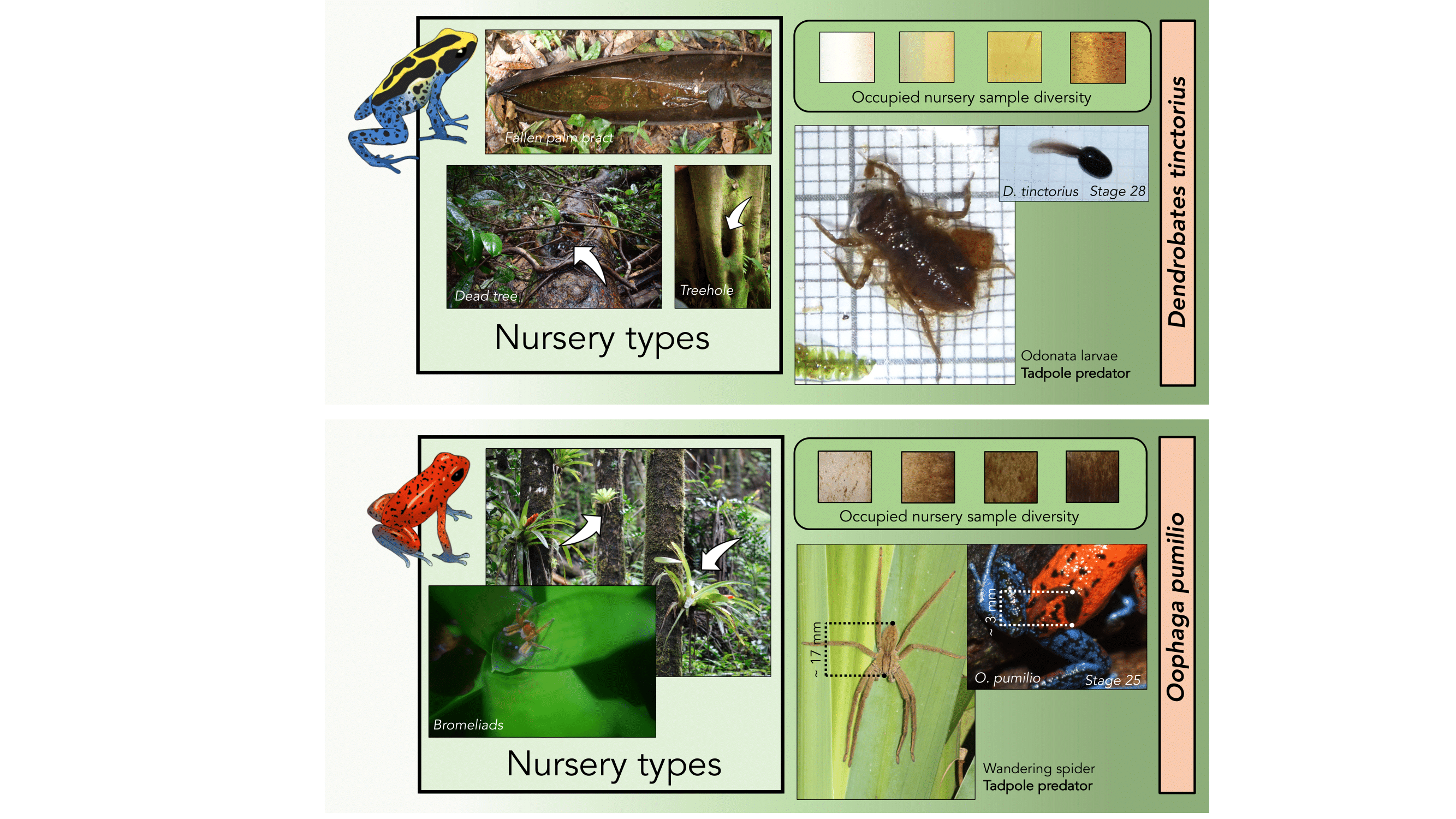
It’s not hard to see the differences in these little ephemeral worlds once you start looking at them. Some are big, some are small. Some have lots of jungle stuff in them (debris, animals, unspecified gunk and goop) while others are as clear as drinking water. Looking at the water of these nurseries, I thought to myself that there has to be an effect of growing up in a tea-coloured pool.
Do tadpoles raised in tinted water see the world through rose-coloured glasses? Or is it more like growing up in the shadows, where one must navigate an entire universe with the lights turned off?
Embedded in this question we can disentangle the threads of biology: does the visual system of tadpoles adapt to turbid conditions (or do other senses compensate for the challenge to vision) or are tadpoles doomed to simply have to survive in ephemeral darkness?
As we do what science does, the “I” quickly became “We” as this idea gained traction with my mentors and friends. We began to think more about this question and we thought it would be interesting to consider how tadpoles with different life histories may respond differently to growing up in turbid conditions– how does growing up in coloured water affect the behaviour of a voracious predator versus a that of a tadpole dependent on maternally-provided food?
Vision plays an important role for both of these species’ interactions: one to subjugate, kill, and consume (our beloved cannibal tadpole: Dendrobates tinctorius) and the other must recognise incoming mothers (or incoming predators!) and respond appropriately (a beautiful Costa Rican poison frog called Oophaga pumilio). So, we thought why not test how wild tadpoles (that have developed in a wide range of nurseries) respond to the visual stimuli of various predators!
I ran these experiments in French Guiana and Costa Rica; in French Guiana I used D. tinctorius tadpoles from various pools and paired tadpoles with the visual stimulus of either a conspecific (remember, these guys are cannibals) or a dragonfly larva, which is an avid tadpole predator. In Costa Rica, I collected O. pumilio tadpoles from various bromeliad axils and paired tadpoles with either a conspecific (while not predatory, previous work has established that tadpoles will kill each other if they are placed together in a pool) or a spider.
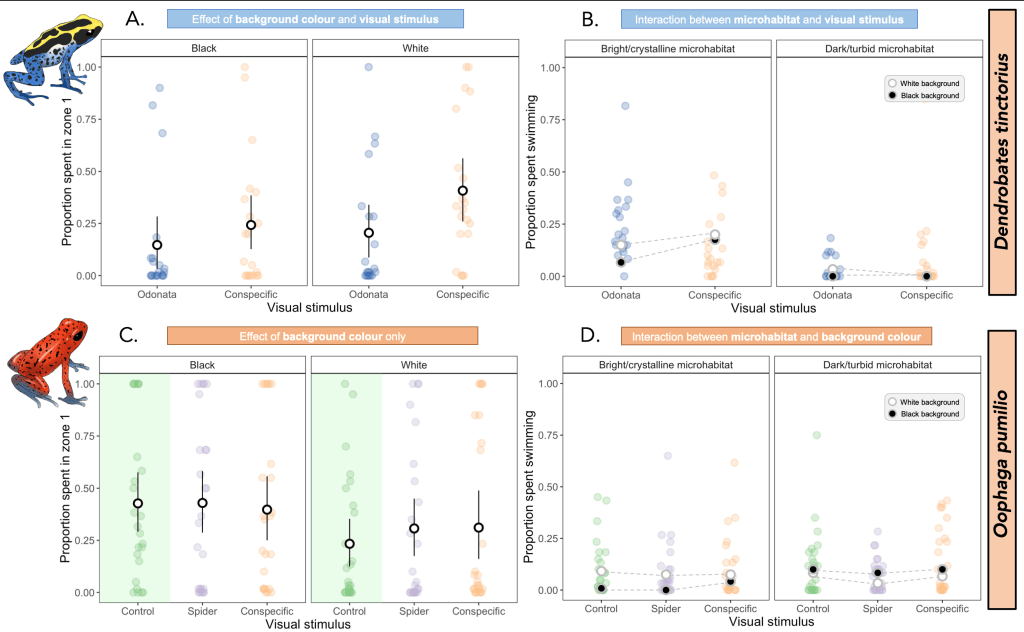
Here’s what emerged as true. First of all, the developmental conditions of larval nurseries (the little coffee-mug universes) play an important role in how both species perceive risk (Panels B, D). We see that D. tinctorius tadpoles from turbid conditions are much less active when faced with any visual stimuli (Panel B) and that tadpoles from clear pools make the distinction between visual stimuli, where tadpoles move a lot more and interact more with the visual stimulus (i.e. centre of the arena) when they see conspecific tadpoles! O. pumilio shake up the box too– tadpoles are more active in novel contexts that more closely match the luminosity of their developmental environments. This is a fancy way of saying tadpoles from clear pools are more active on white backgrounds while tadpoles from turbid pools are more active on black backgrounds.
Overall, these data show us that the natural history of both species shapes species’ behaviours. The colour of a tadpole’s universe has measurable effects on their responses in novel contexts, just in different ways.
These results have important implications for visual plasticity of animals in response to environmental change. Our results serve as a useful model to understand animal responses to habitat disturbance and how communities may shift when visually-guided animals are challenged.
**Personal tangent**: First, for me personally– I got to take a little thought in my head and watch it play out in real life. That’s enormously satisfying (and you can read about how I got to this point from a previous blog post). Professionally, I learned how to quantify pool darkness (turbidity is actually not the **technically correct** word in our case here, but we won’t get into that because the verbiage surrounding light and photic environments will keep us here for years) using various methods, I had the opportunity to work with a new frog species in Costa Rica, and I just generally grew as a person interacting with all these new people and scientists in varied contexts. So thank you everyone for teaching me, supporting me, and nurturing these ideas into something coherent and beautiful! A big thank you to Bibiana Rojas (KLIVV), Jenny Stynoski (U of Costa Rica) and Carola Yovanovich (U of Sussex) for being the most wonderful people ever in the history of ever.
Up in the treetops hides an entire unexplored verdant palace.
It’s easy to forget that there are spheres of existence that occur beyond what is directly observable–we could get poetic here and talk about the feeling of looking out into the stars or into the ocean’s abyss, but from a more ordinary standpoint, it’s easy to forget about life directly under our feet or above our line of sight.
In the Amazon with trees reaching several stories tall, your mind might wander to the birds and monkeys that so noisily call from above– but there are other animals that make use of the vertical gradient from the forest floor to the treetops that aren’t winged or . . . thumbed(?) and make for much less annoying roommates. We, of course, are led back to our fabulous amphibian friends. In this study I am here to take you on three different narratives between the lives and interactions of three different species of Neotropical frogs and provide you a brief introduction to a tadpole’s guide to the galaxy.
Allobates femoralis
Illustrations by Andrius Pašukonis
Osteocephalus oophagus
Dendrobates tinctorius
In this study, we went through the jungle looking for babies.
Which is a great sentence on its own, but I’ll elaborate. Following babies is good for several reasons: first, it saves us the trouble from having to follow the parents which would (1) be exhausting and (2) super resource intensive and not realistic for me to accomplish. By identifying tadpoles, we can say with certainty that at least one adult of that species has been at the location in a not-so-distant past. Secondly, these microhabitats (also called phytotelmata, also called pools) are . . . small. . . and thus, it’s quite easy to measure a ton of chemical aspects of the pool, identify the kind/density of predators, and cons/heterospecifics.
This gives us a really beautiful picture of the ecology of these habitats and also shines a light into the decisions parents make when deciding where to deposit their tadpoles. What is shaping deposition decisions in frogs, and does it change dramatically based on the natural history of the species?
You might be tempted to think that water accumulating in plants and trees and dead palms is created equal. But not to the frogs, friends. Not to the frogs.
A brief backgound: Allobates femoralis is a small poison frog that can’t climb at all; poor little-ground laden creatures (note: they are fast as hell terrestrially and it is an art to catch them). They are great parents, where fathers will dutifully carry their babies to small pools of water throughout the jungle. Osteocephalus oophagus is an arboreal frog, which means that they chill in the trees pretty much their whole lives. These guys are a bit different from the poison frogs: they deposit their eggs in small pools (into which the tadpoles then hatch)– then mamas will come and feed their babies unfertilized eggs as a nutritious snack throughout tadpole development!
Dendrobates tinctorius is a little amphibious spider money with amazing parenting skills and is just overall just the best creature out there. Their tadpoles are aggressive cannibals and survive an amazing range of chemical properties.
So, what did we find, climbing ’round the forest for two years?
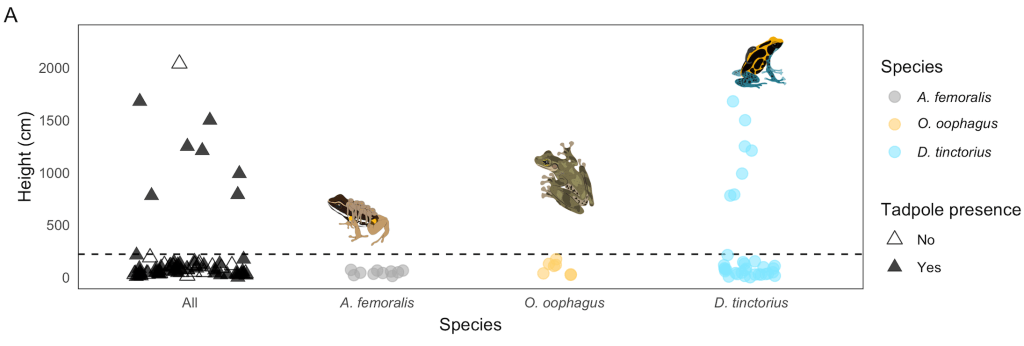
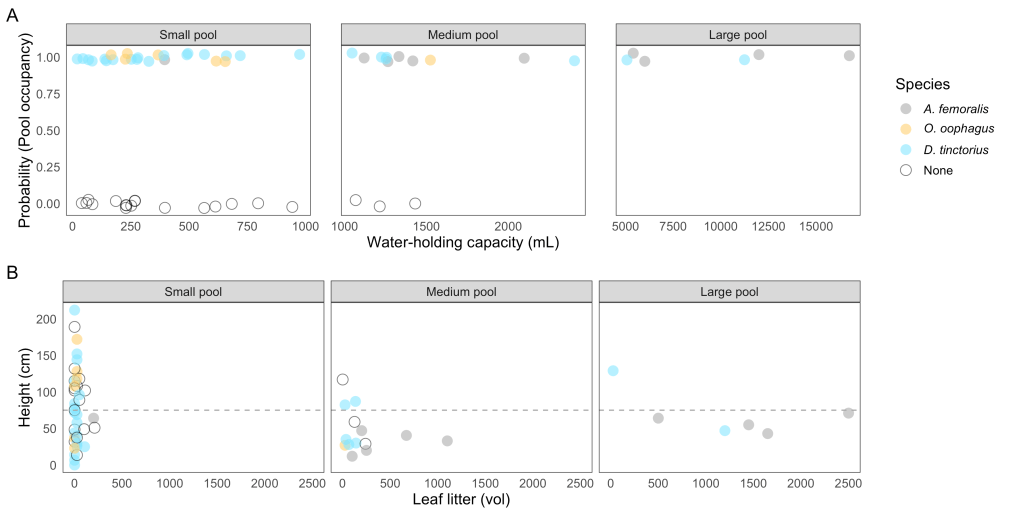
Unsurprisingly, we see that A. femoralis dads deposit their babies on the ground, which is not all that surprising as adults can’t climb. O. oophagus, the arboreal frog, actually climbs down these humungous trees to deposit their egg clutches around 1.5-2m in height (6ish feet). We explore why parents might do this below. Finally, D. tinctorius can’t be bothered to care: from the forest floor to the tops of trees, dads will sometimes make huge energetic decisions regarding where to put their babies.
So, into what kinds of pools are these babies being deposited within their respective vertical columns?
The diversity of occupied phytotelmata pools throughout the jungle.
Interestingly, for A. femoralis (grey points below) and O. oophagus (yellow points below), deposition decisions are pretty clearly be delineated by pool size and height– these decisions fit nicely within the context of the parental care strategies of both species.
We find that O. oophagus tadpoles almost exclusively occur in small phytotelmata with close to zero leaf litter (a variable that can help inform water turbidity); in other words: small, clear tiny pools. And this makes sense, right? Remember that mamas feed their babies trophic eggs, so clear water is probably important for the maintenance of potential feeding cues; also, feeding their babies means consistent, nutritious meals, which may be what allows them to choose these extremely small pools (higher risk of drying out counteracted by short development times from yummy eggs). Small pools also exclude other aquatic predators (such as dragonfly larvae), which is another advantage of choosing these dangerously small pools. A. femoralis tadpoles on the other hand occur in larger pools terrestrially– these pools can be big and murky– this means more predator risk, but also more food opportunity (i.e. detritus) resulting from the decomposing leaves, which is what tadpoles of these species primarily eat. Leaves and sticks in these pools also provide some much needed hiding places for these tadpoles to hang out and hide.
Again, here we are stumped by the amazing flexibility of D. tinctorius. Because these tadpoles appear to tolerate such vast conditions, we spend the rest of our time looking at the pool choices of this species to see if there was any particular condition they preferred.
Illustration by Andrius Pasukonis
Well, the story is not so simple– but in broad strokes here’s what we found: D. tinctorius tadpoles occur in higher densities in pools that occur higher in the treetops, these pools are also chemically distinct– they have higher alkalinity (KH), hardness, and salinity– which may all be important variables for tadpole growth and development (which is the next step to experimentally explore).
Overall, the beauty of this study are its contributions to natural history and behaviour of poorly studied species. I think one of the coolest parts of being a biologist is having the opportunity to work with the natural world, ask questions, and slowly untwine the nature of why things are and how they came to be. If you enjoyed this brief overview, feel free to take a look at our paper in Ecology and Evolution which you can access here .
When we observe animals, be it in the jungle, under water, or even in your own back yard, we learn to recognize individuals over time. Maybe you know your neighbourhood squirrel because it has a ripped ear, or you notice a butterfly because it has a unique pattern. This process, the act of distinguishing individuals, is fundamental in behavioral research.
But what do you do when all of your individuals within a population look similar?
In this study, I attempted (along with one of my best friends, Guillermo Garcia-Costoya and my advisor Bibiana Rojas) to tag young poison frog tadpoles with fluorescent elastomer tags. This is especially interesting because, to date, tropical larval amphibians had never been tagged; further, we marked the smallest and youngest amphibious animal ever recorded.
.
Now you see me, now you don’t:
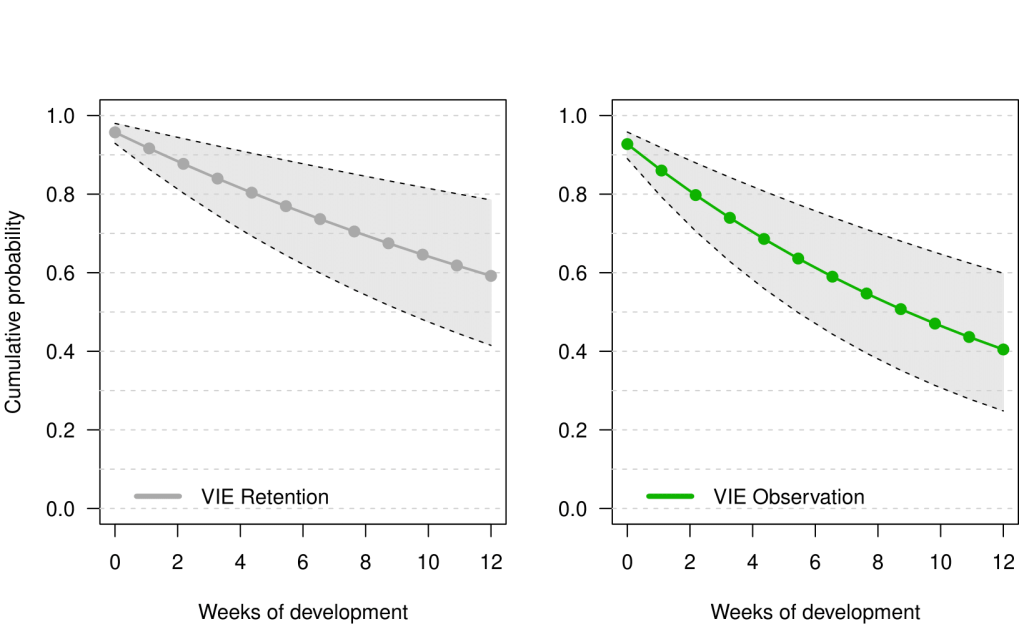
When tracking tags across development we find that the probability of retention and observation differ across time. This means that just because someone didn’t observe the tag doesn’t mean that the tag is actually lost. This is important to take into account when working with mark-recapture studies.
What’s so cool about elastomers is that they’re small and durable. We now have work showing that we can tag tiny little tadpoles (before they have cool back patterns or are transported by their fathers!) and find out where they are carried or even how tadpole communities change over time in small water holdings. This methodology will hopefully be of use to future biologists who working in conservation or on behavior in the tropics.








 Chloe Fouilloux