In life we don’t often get the chance at do-overs. How would things be different if I had the brain of today to solve yesterday’s challenge?
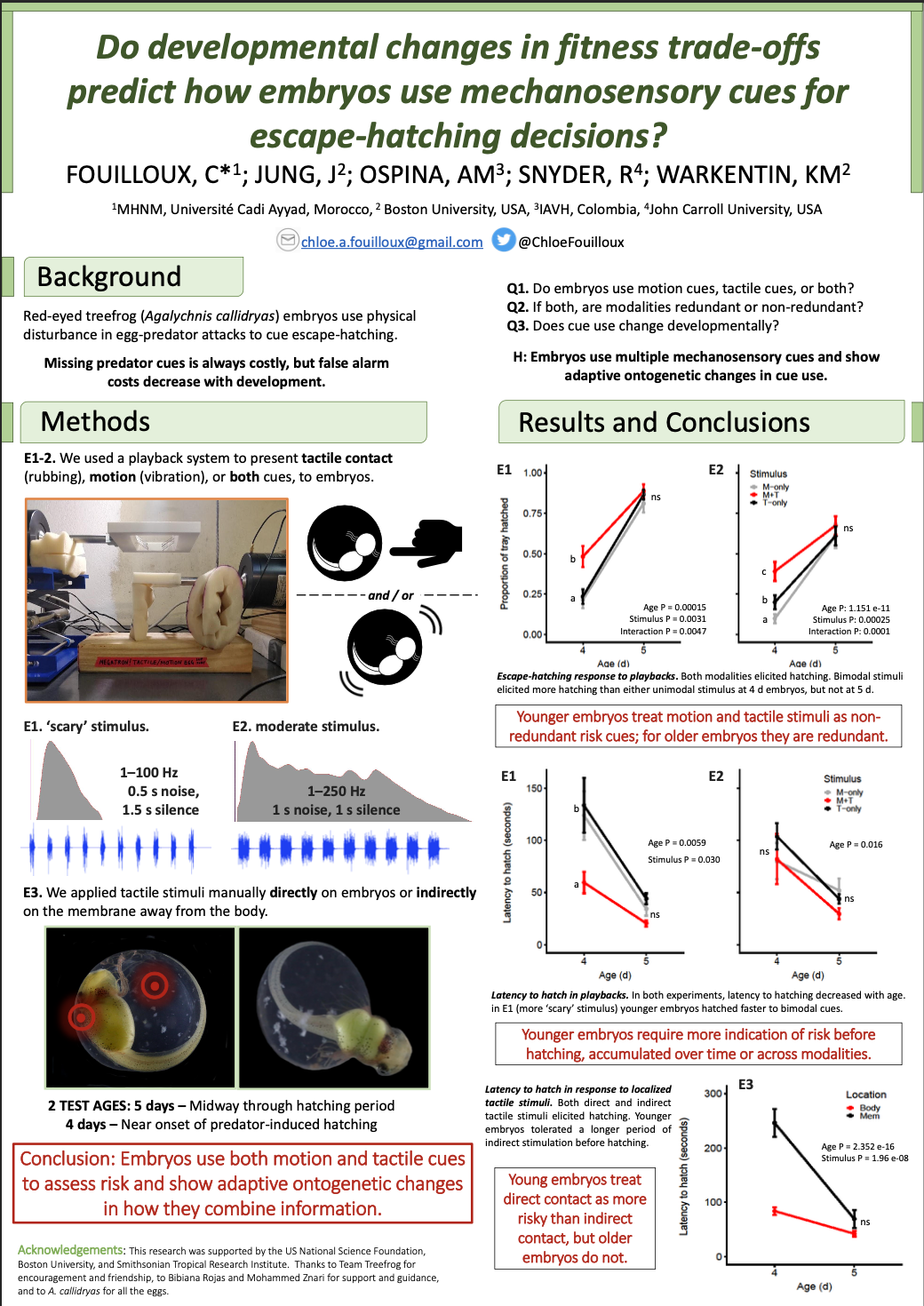
Well, I had the rare opportunity to do just that by being able to redesign a conference poster from my very first Ph.D conference in 2019 at ESEB in Turku, Finland. I had just barely started my program at the University of Jyväskylä and was presenting work I had done in Panamá with Karen Warkentin while living in Morocco working with Mohammed Znari. It was quite the time for a tadpole to be hatched into the big ol’ pond of science.
If you want to another example that more explicitly outlines design concepts, check out the work I did with Eldon’s poster redesign here.
Hey #eseb2019, thank you for creating such a wonderful opportunity to learn and present during the first poster session. Lucky for feedback and constructive criticism on my presentation and work. Please support a young and eager scientist by voting for poster 61 on the app! 🐸🤓 pic.twitter.com/JMJqd8CDfr
— Chloe Fouilloux (she/her) (@ChloeFouilloux) August 21, 2019
So, what changed five years later? First, I restrict poster content to my golden 250-word limit. Make the threshold for engagement at low as possible: bold colours, bold images, bold. . . everything. I also aim to go for repetition in shape use by capturing the circle of the egg in the repetition of circles throughout the poster. Finally, I aim for a more consistent use of colour by limiting my palette for emphasis and narrative flow. If you find yourself really challenged by these constraints, make a QR-code as a kind of “supplementary materials”– if people really want to know what your set-up looked like, they’ll scan it. You can throw additional plots and references on there too.
So, take the leap! Dare yourself to look over your old work. Be kind to who you were and bathe in the warmth of how wonderfully far you’ve come. I can’t wait to see how I would shred all my previous work five years from now!
Interested in reading the full article? Access our peer-reviewed manuscript in Evolutionary Ecology
“Some things in life are worth fighting for. . .”— for animals the defense of space, known as territoriality, usually functions to safeguard valuable resources like food and mates. However, for a remote species of tropical frog, we have recently discovered a surprising addition to things that adults find worth defending: suitable nurseries.
Human parents are well aware of the lengths some will go to to secure a first-rate nursery school for their children. Oddly enough, a parallel can be found on top of the world’s tallest single-drop waterfall (Kaieteur Falls, Guyana) where there exists the only known population of golden-coloured rocket frogs (Anomaloglossus beebei). These small poison frogs spend their entire development in giant tank bromeliads (i.e., 2-4 meters tall, Brocchina micrantha): within these plants, eggs are laid in the lower leaves and hatch as tadpoles. Fathers then transport their young to water-filled leaf axils higher in the plant through an elaborate piggyback ritual where tadpoles cling to a father’s back. Tadpoles must survive in selected leaf axils until metamorphosis, meaning the quality of a nursery can have profound implications for the success of the tadpoles contained within them.
Of course, if a frog’s only suitable breeding-ground is on top of an isolated waterfall in the middle of the Guyanian Amazon, it isn’t surprising that there isn’t room for everyone. Thus, in addition to their intense parental care duties, male rocket-frogs are extremely territorial and aggressively defend established areas in bromeliads (which consist of multiple leaves) from potential intruders. Along with Johana Goyes Vallejos (University of Missouri) and James Tumulty (College of William and Mary) we wondered if the intense territoriality of males had any relationship to their intensive care-giving duties. In a bromeliad, what is the function of the space males are defending? Our study, recently published in Evolutionary Ecology, consisted of first characterizing leaf axils in bromeliads to understand the differences between pools that were used as nurseries versus those that were not. Once having established the “high-quality” parameters that characterized occupied pools, we took advantage of Tumulty’s long-term mark-recapture dataset to see if the location of high-quality nurseries coincided with the territories of established males. Indeed, these characteristic pools occurred significantly more frequently within defended territories.
In other words, males defend areas that may benefit their reproductive output in a non-immediate future– a cognitive feat of future planning that is not typically associated with amphibians.
In human terms, these parents are securing spots in Montessori schools before they were even pregnant.
The combination of the geographical isolation and specialized behaviors that characterize golden rocket frogs make them a key species to unlock our understanding of the evolution of parental care and cognition in amphibians and beyond.
Up in the treetops hides an entire unexplored verdant palace.
It’s easy to forget that there are spheres of existence that occur beyond what is directly observable–we could get poetic here and talk about the feeling of looking out into the stars or into the ocean’s abyss, but from a more ordinary standpoint, it’s easy to forget about life directly under our feet or above our line of sight.
In the Amazon with trees reaching several stories tall, your mind might wander to the birds and monkeys that so noisily call from above– but there are other animals that make use of the vertical gradient from the forest floor to the treetops that aren’t winged or . . . thumbed(?) and make for much less annoying roommates. We, of course, are led back to our fabulous amphibian friends. In this study I am here to take you on three different narratives between the lives and interactions of three different species of Neotropical frogs and provide you a brief introduction to a tadpole’s guide to the galaxy.
Allobates femoralis
Illustrations by Andrius Pašukonis
Osteocephalus oophagus
Dendrobates tinctorius
In this study, we went through the jungle looking for babies.
Which is a great sentence on its own, but I’ll elaborate. Following babies is good for several reasons: first, it saves us the trouble from having to follow the parents which would (1) be exhausting and (2) super resource intensive and not realistic for me to accomplish. By identifying tadpoles, we can say with certainty that at least one adult of that species has been at the location in a not-so-distant past. Secondly, these microhabitats (also called phytotelmata, also called pools) are . . . small. . . and thus, it’s quite easy to measure a ton of chemical aspects of the pool, identify the kind/density of predators, and cons/heterospecifics.
This gives us a really beautiful picture of the ecology of these habitats and also shines a light into the decisions parents make when deciding where to deposit their tadpoles. What is shaping deposition decisions in frogs, and does it change dramatically based on the natural history of the species?
You might be tempted to think that water accumulating in plants and trees and dead palms is created equal. But not to the frogs, friends. Not to the frogs.
A brief backgound: Allobates femoralis is a small poison frog that can’t climb at all; poor little-ground laden creatures (note: they are fast as hell terrestrially and it is an art to catch them). They are great parents, where fathers will dutifully carry their babies to small pools of water throughout the jungle. Osteocephalus oophagus is an arboreal frog, which means that they chill in the trees pretty much their whole lives. These guys are a bit different from the poison frogs: they deposit their eggs in small pools (into which the tadpoles then hatch)– then mamas will come and feed their babies unfertilized eggs as a nutritious snack throughout tadpole development!
Dendrobates tinctorius is a little amphibious spider money with amazing parenting skills and is just overall just the best creature out there. Their tadpoles are aggressive cannibals and survive an amazing range of chemical properties.
So, what did we find, climbing ’round the forest for two years?
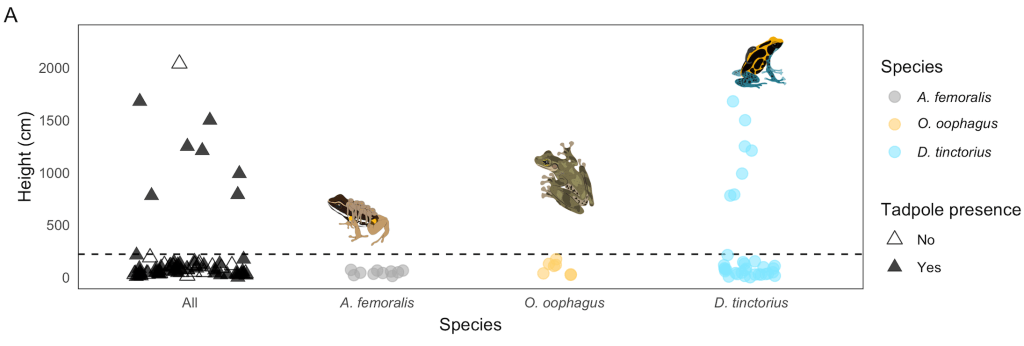
Unsurprisingly, we see that A. femoralis dads deposit their babies on the ground, which is not all that surprising as adults can’t climb. O. oophagus, the arboreal frog, actually climbs down these humungous trees to deposit their egg clutches around 1.5-2m in height (6ish feet). We explore why parents might do this below. Finally, D. tinctorius can’t be bothered to care: from the forest floor to the tops of trees, dads will sometimes make huge energetic decisions regarding where to put their babies.
So, into what kinds of pools are these babies being deposited within their respective vertical columns?
The diversity of occupied phytotelmata pools throughout the jungle.
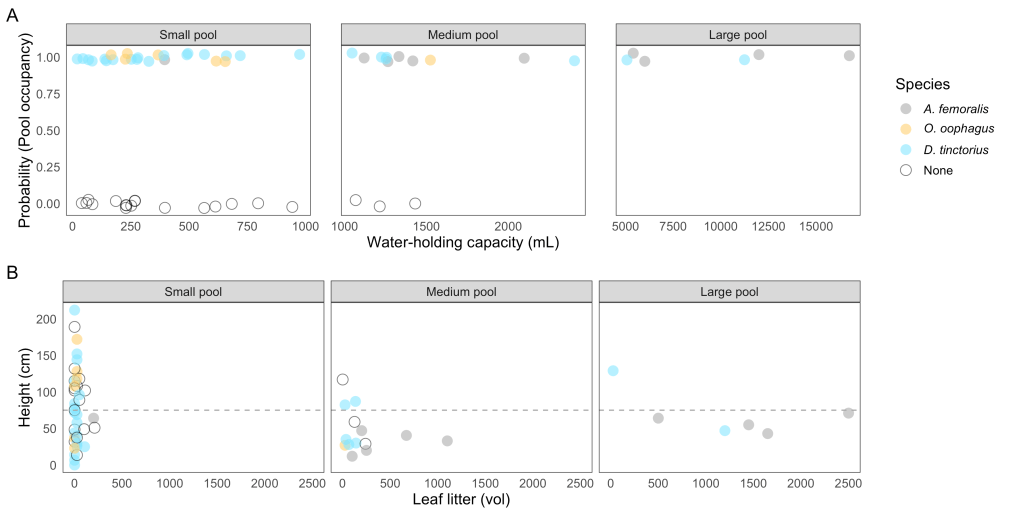
Interestingly, for A. femoralis (grey points below) and O. oophagus (yellow points below), deposition decisions are pretty clearly be delineated by pool size and height– these decisions fit nicely within the context of the parental care strategies of both species.
We find that O. oophagus tadpoles almost exclusively occur in small phytotelmata with close to zero leaf litter (a variable that can help inform water turbidity); in other words: small, clear tiny pools. And this makes sense, right? Remember that mamas feed their babies trophic eggs, so clear water is probably important for the maintenance of potential feeding cues; also, feeding their babies means consistent, nutritious meals, which may be what allows them to choose these extremely small pools (higher risk of drying out counteracted by short development times from yummy eggs). Small pools also exclude other aquatic predators (such as dragonfly larvae), which is another advantage of choosing these dangerously small pools. A. femoralis tadpoles on the other hand occur in larger pools terrestrially– these pools can be big and murky– this means more predator risk, but also more food opportunity (i.e. detritus) resulting from the decomposing leaves, which is what tadpoles of these species primarily eat. Leaves and sticks in these pools also provide some much needed hiding places for these tadpoles to hang out and hide.
Again, here we are stumped by the amazing flexibility of D. tinctorius. Because these tadpoles appear to tolerate such vast conditions, we spend the rest of our time looking at the pool choices of this species to see if there was any particular condition they preferred.
Illustration by Andrius Pasukonis
Well, the story is not so simple– but in broad strokes here’s what we found: D. tinctorius tadpoles occur in higher densities in pools that occur higher in the treetops, these pools are also chemically distinct– they have higher alkalinity (KH), hardness, and salinity– which may all be important variables for tadpole growth and development (which is the next step to experimentally explore).
Overall, the beauty of this study are its contributions to natural history and behaviour of poorly studied species. I think one of the coolest parts of being a biologist is having the opportunity to work with the natural world, ask questions, and slowly untwine the nature of why things are and how they came to be. If you enjoyed this brief overview, feel free to take a look at our paper in Ecology and Evolution which you can access here .






 Chloe Fouilloux