Reddit and Breast Reduction

Uncategorized

There are many places that we get our information, and in 2024, it’s hard not to ask Dr. Google just about everything that is going wrong (or right?) with us. Honestly, the spiral is a rite-of-passage into navigating the internet. But something that was new to me (yes, yes, I live under a massive rock) are forums. Enter: Reddit.

Essentially, a lot of people can come together and contribute information that is linked around a common thread. Having an operation? Well, suddenly you have access to the experiences, suggestions, and interactions between thousands of people. Life is daunting, surgery is scary, and suddenly there are hundreds of people that have gone through the exact same thing, contributing their lived experience! What a rush!

While this lived experience is something to cherish, it is important that these threads exist in a vast sea of data. If your searches and keywords are biased, you will bias the responses that are filtered to address your question. I had lots of questions, and found lots of answers! Most of them opposing each other! Gah! In this frustration, I tried to compile all of the “answers” across threads grouped within a forum (i.e. r/Reduction, “swelling”) to get a grasp on the structure of the data.


Operation techniques

TL;DR Drain usage is more about the surgeon than about you.

Now this was really interesting to plot out. I was able to get more than 100 answers, and the proportion of who got drains and who didn’t was almost exactly 50/50! The people who had drains weren’t having more tissue removed, didn’t seem to fit a specific demographic, and didn’t appear to come from a specific region. Surgery outcomes seem to be great for those with and without it. All in all, it really just seems like something that is surgeon specific. Of those that did get drains, average time was about 5 days.

Post-op recovery

TL;DR Your brain is ready to go, but your body is not.

These data look left-skewed, where we see more swelling sooner after operation. I was surprised that these data were not MORE skewed– the mean peak swelling is at 1MPO! I think that this may relate to patients getting back to work, or becoming too active too early? Potentially eliciting inflammatory responses of still healing tissues.

Post-op recovery

TL;DR It’s gonna take many months before you know.

These data are suuuuuper spread out! See how the peaks aren’t are dramatic in the green graph compared to the pink one? It means that everyone’s experiences are much more varied. Here, the mean actually sits around 4 months post-op, which is earlier than the 6-month number we just kind of patch on.


How to read "raincloud" plots. The "mountain" is the spread of the data-- the higher the peak, the more points occur around that given value. This is echoed in the coloured band under the distribution: here, the white point indicates the group mean and the coloured slabs are credible intervals. The darker the colour indicates that we are more statistically certain that a point should occur in that given range. The little points are the raw data I scrubbed from the forums! (forae?)

Check out the live post on Reddit yourself 😉

DESIGN PORTFOLIO EXAMPLE :: Chloé’s SCIENTIFIC CONFERENCE POSTER

Uncategorized

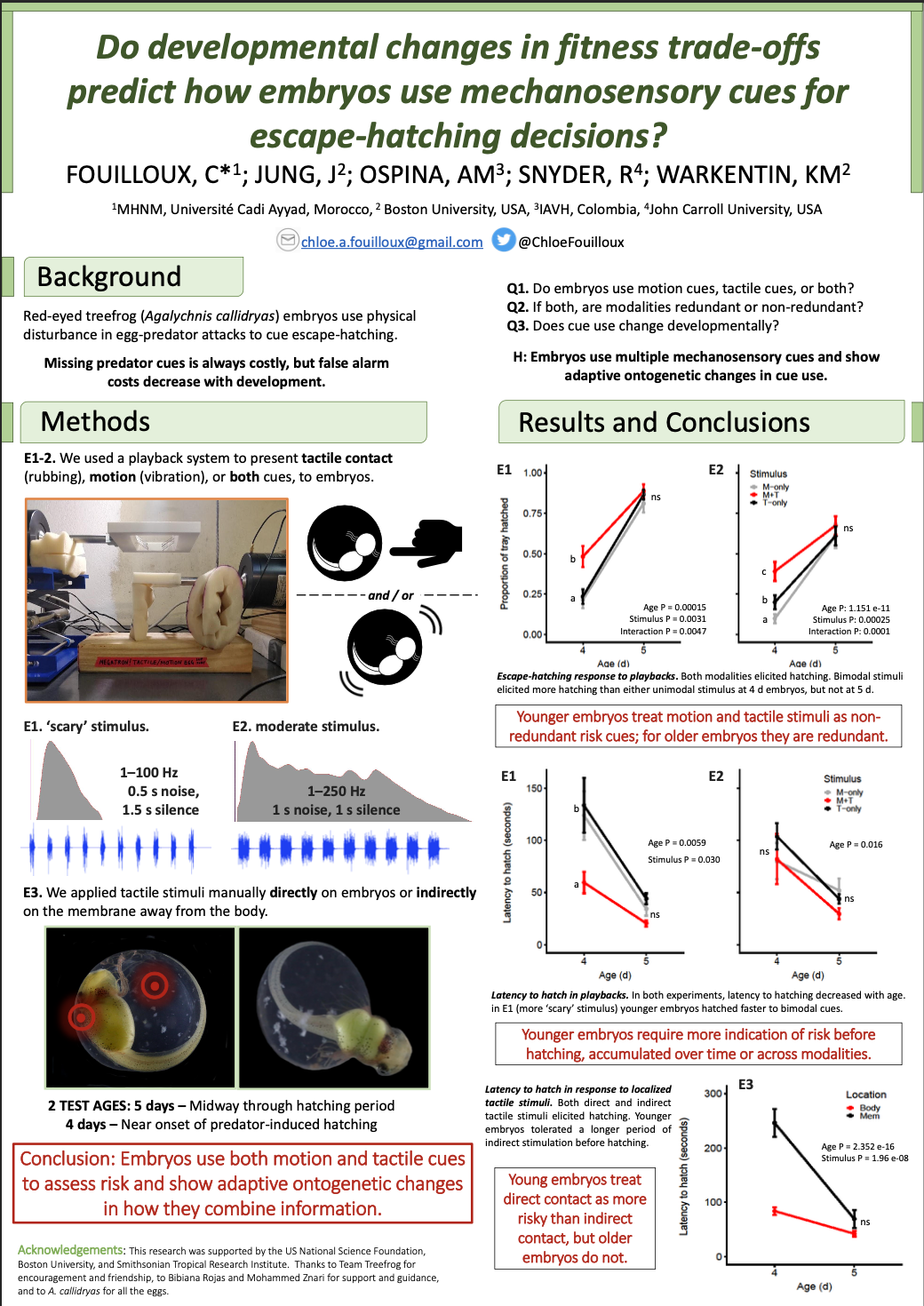
Well, I had the rare opportunity to do just that by being able to redesign a conference poster from my very first Ph.D conference in 2019 at ESEB in Turku, Finland. I had just barely started my program at the University of Jyväskylä and was presenting work I had done in Panamá with Karen Warkentin while living in Morocco working with Mohammed Znari. It was quite the time for a tadpole to be hatched into the big ol’ pond of science.


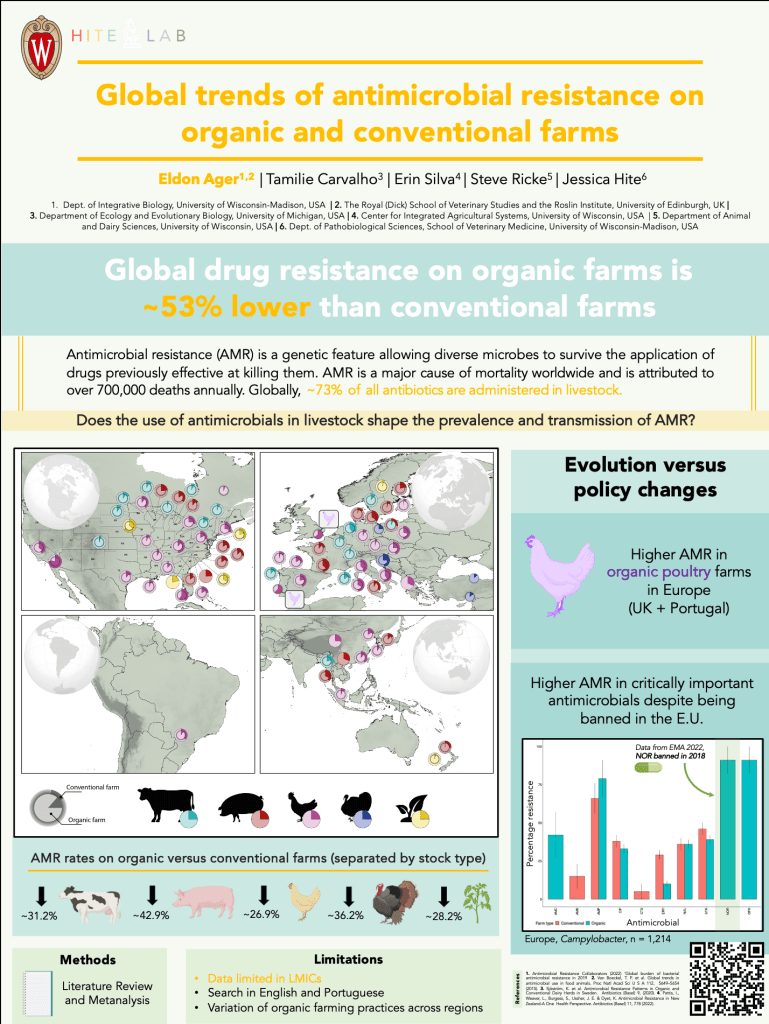
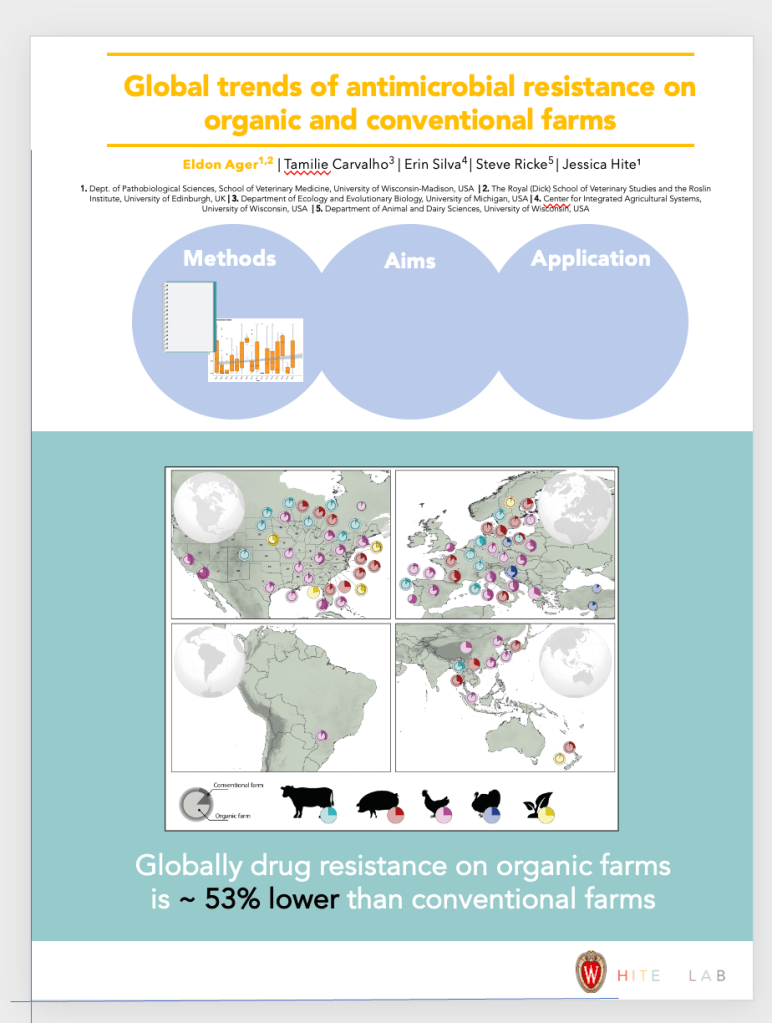
If you want to another example that more explicitly outlines design concepts, check out the work I did with Eldon’s poster redesign here.


So, what changed five years later? First, I restrict poster content to my golden 250-word limit. Make the threshold for engagement at low as possible: bold colours, bold images, bold. . . everything. I also aim to go for repetition in shape use by capturing the circle of the egg in the repetition of circles throughout the poster. Finally, I aim for a more consistent use of colour by limiting my palette for emphasis and narrative flow. If you find yourself really challenged by these constraints, make a QR-code as a kind of “supplementary materials”– if people really want to know what your set-up looked like, they’ll scan it. You can throw additional plots and references on there too.


So, take the leap! Dare yourself to look over your old work. Be kind to who you were and bathe in the warmth of how wonderfully far you’ve come. I can’t wait to see how I would shred all my previous work five years from now!

Design Portfolio Example :: Scientific conference poster

Uncategorized

Process shown with kind permission from Eldon Ager.

When designing a poster, my guiding light is to limit myself to 250 words and fewer than 3 graphs. You have only half a second– the time someone is walking by– to win their attention.


Design

The process


You aren’t going to get it on the first try. Or the second. Or the third.


Trust me, I know it’s difficult. But imagine in a conference of 100s of posters after many hours of talks (poster sessions are usually scheduled at the end of the day, or at the end of a conference), people are tired and sometimes it’s hard to engage in a meaningful way after riding a conference high all day. So, cut cut cut. Say it in pictures, say it in shapes. If someone really wants to know more, they will scan a QR code, e-mail you, or talk to you if you are there in person!

Make it as easy as possible for people passing by to understand and get excited by your work.


The Sweet Escape

Uncategorized

Work funded by Karen M. Warkentin and done in collabortion with KMW, Julie Jung, Ana M. Ospina, and Rachel Snyder.

Also find the poster, presented by me at the 2019 ESEB conference in Turku Finland here

It’s not only Gwen Stephani that sings about a Sweet Escape. . . turns out that the natural world is full of pretty ferocious predators that have evolved a myriad of adaptations to rip, tear, dismember, and sneak up on their unsuspecting prey. But predation isn’t a one way street– prey have developed some evasion tactics of their own. . .

But you already knew that. Crabs have shells, gazelles use evasive darting tactics, and stick-bugs use morphological camouflage to look like. . . well. . . sticks! But did you know that there are embryos, meaning individuals that haven’t even hatched from their egg capsules yet, use information from the outside world to that trigger escape hatching responses?

That’s right, and we see this in red-eyed treefrogs– imagine a snake sneaking up a tree branch where an unsuspecting clutch (which has no parent to protect it, as there is no parental care in the species) hangs over a nearby pool. Well, instead of just laying around and becoming fresh snake food, embryos cue on both tactile and motion modalities to inform premature escape hatching. Read more about our findings in our abstract and conference poster below! (with hopeful full-length paper coming out in 2020 🙂 )

ABSTRACT— When defense is more costly, prey should differentiate more strongly between predator cues and benign stimuli and may therefore use more sources of information. Red-eyed treefrog (Agalychnis callidryas) embryos hatch prematurely to escape from egg-eating snakes and wasps, cued by physical disturbance in attacks. Missing predator cues is always costly, but false alarm costs decrease with development. We assessed developmental changes in how embryos use and combine information from two sensory modalities, using a playback system to present motion (shaking), tactile contact (rubbing), or both cue types to eggs in custom-made trays at two ages. Younger embryos showed a stronger hatching response to bimodal over unimodal cues. This synergistic effect disappeared in older embryos, which responded equally strongly to unimodal and bimodal cues and had a shorter latency to hatch. This indicates younger embryos – facing higher predation risk as tadpoles – use more information for their hatching decisions. We also investigated changes in response to tactile cues (simulated wasp attack) manually applied directly to embryos through the capsule (higher threat) or on the capsule away from embryo (lower threat). Younger embryos hatched faster in response to direct tactile contact than capsule-only contact, whereas older embryos responded equally to both. Both within and across sensory modalities, developmental changes in embryos’ cue use are consistent with ontogenetic adaptation, based on improved survival chances outside the egg. Embryo hatching timing can be crucial for survival, and the cognitive processes underlying their behavioral responses have likely been shaped by developmentally changing selection pressures.